Unfortunately the pictures of the linen that have been recently uploaded on the blog are not very clear or rather should say,they don't show their true colours! The table cover with scallops,embroidery & a border has story.This piece originally was a "lehenga"(long skirt)of my great grandmother(paternal).The scalloping & the embroidery was done by my grandmother for her mother-in-law.Somewhere along the line it must have come back to her.My grandmother wore sarees as her daily attire,though.She & my mother both had quite a few of such lehengas neatly kept in their cupboards.These lehengas were worn with hiplength, loosely stitched ornate blouses.Over this a three meters long "dupatta" or"odhani"was worn.This dupatta which was tucked in the lehenga & then flung across the shoulders,covered their heads as well.These dupattas again used to be quite ornate with hand made laces & embroideries.They were invariably made of sheer materials.The border you see on this particular table cover has been retreived from one such dupatta.This cross stitch too was done by my great grandmother.
My daughter,Manasi was the first great grandchild my grandmother had & was very fond of her.She gave quite a few of such lehengas to her after she was about 15 years of age.I safe kept all this for her.The ones that are still lying with me are absolutely gorgeous & perhaps when Manasi visits me next month(she is married & resides in the US) I will have those photographed for my blog.
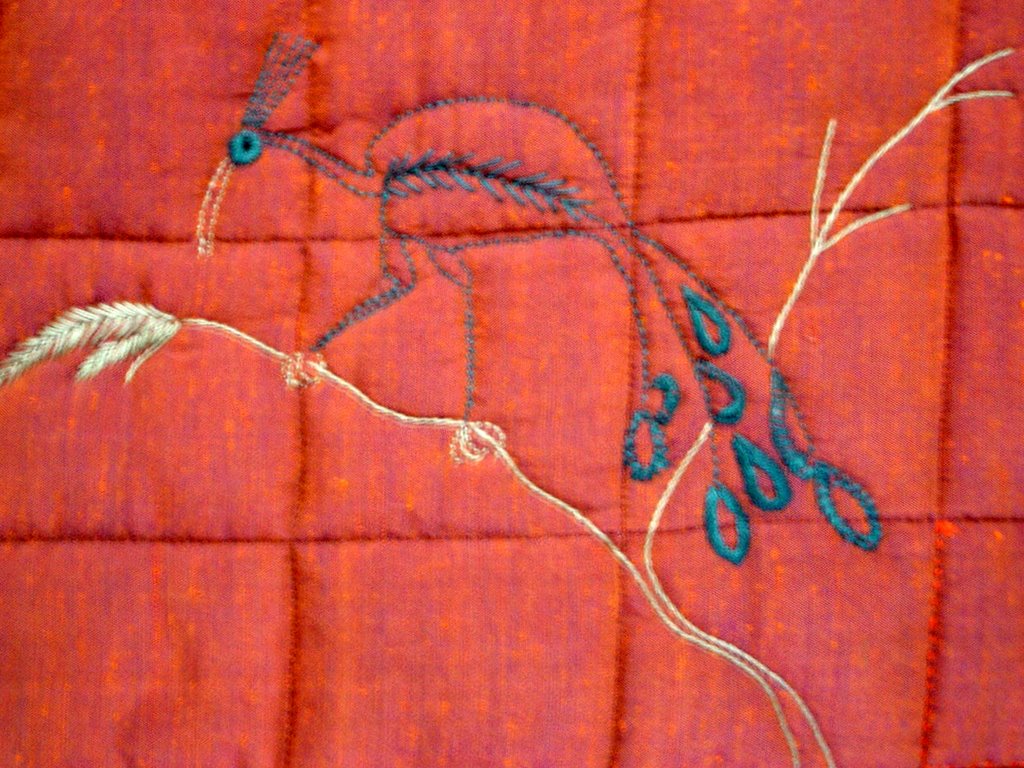
Now lets return to our story of the table cover.Last time when Manasi visited me she took a couple of them with her to the US to wear on some special occasions.This one was quite frayed with holes in it.With her due permission I decided to convert it into a "display"table cover. I first cut it in the centre to make one long piece.I had to join a matching silk border to make it wider.Then I put a thickish lining to strengthen the old fabric.Tiny flowers were then embroidered over it to cover the holes.The crossstitch border which earlier I had put on my saree came over the machine stitched joint.
As I said earlier,I have piles & piles of such antique heirlooms some of which I am enjoying after restoring them.Another such lehenga,which my grandmother had worn in her wedding & later my sister wore in her wedding was cut into three pieces by my mother & one piece was handed over to me.I have framed that one.Its the blue brocade you see with again a handmade border by my great grandmother.I wish my adoring grandmother was around to see my blog & know that what she lovingly passed on to us is being viewed all around the world,courtsey her great grand daughter.
The framed fan pattern also has all heirloom gold & silver laces on the edgings.I have given one such quilted wall hanging to my daughter which has more accent on blues.I shall come back again with some memories about some other linen pieces as well.


This single bedcover was second one of its kind.Ofcourse,the first one had slightly different colour combination.For this pattern I began at the centre.Having the experience of the first one,I kind of knew how many hexagons would be needed.When I made the first single bedcover using this pattern I had to just go on cutting pieces as when requiered.I also realised that I could not lift the stitched part from the floor till all the lines were joined because if I missed out on even one single alignment the design would go wrong.This was because I was machine stitching them, not the traditional handstitching using a paper template & then piecing those together with hand.Even the zigzag joining was with machine,till I reached the turning point. I would leave that & proceed.All those difficult points were subsequently hand stitched. For many days that particular room could not be swept because the pieces spread on the floor could not be disturbed! The fabrics used here are all Khadi. Thats made from handspun cotton & then woven on "charkhas",the Gandhi style. I had made hexagon patterns earlier but those were not with a pattern.Just tricoloured hexagons stitched together alternatetly.After making this one with two inch tiny peices,I decided never never to make again.I did make smaller coasters but those were handstitched using paper templates.The bedcover seen in the picture probably will be inherited by my daughter since she understands the hardwork that goes behind such work.I take this cover out on very special occasins like Diwali,the festiwal of light when oil lamps are lighted.


 This single bedcover was second one of its kind.Ofcourse,the first one had slightly different colour combination.For this pattern I began at the centre.Having the experience of the first one,I kind of knew how many hexagons would be needed.When I made the first single bedcover using this pattern I had to just go on cutting pieces as when requiered.I also realised that I could not lift the stitched part from the floor till all the lines were joined because if I missed out on even one single alignment the design would go wrong.This was because I was machine stitching them, not the traditional handstitching using a paper template & then piecing those together with hand.Even the zigzag joining was with machine,till I reached the turning point. I would leave that & proceed.All those difficult points were subsequently hand stitched. For many days that particular room could not be swept because the pieces spread on the floor could not be disturbed! The fabrics used here are all Khadi. Thats made from handspun cotton & then woven on "charkhas",the Gandhi style. I had made hexagon patterns earlier but those were not with a pattern.Just tricoloured hexagons stitched together alternatetly.After making this one with two inch tiny peices,I decided never never to make again.I did make smaller coasters but those were handstitched using paper templates.The bedcover seen in the picture probably will be inherited by my daughter since she understands the hardwork that goes behind such work.I take this cover out on very special occasins like Diwali,the festiwal of light when oil lamps are lighted.